
A Trained Eye to Spot a Treasure
How to tell if gold, silver, pearls, and stones are real at thrift stores, estate sales, and in Grandma’s jewelry box
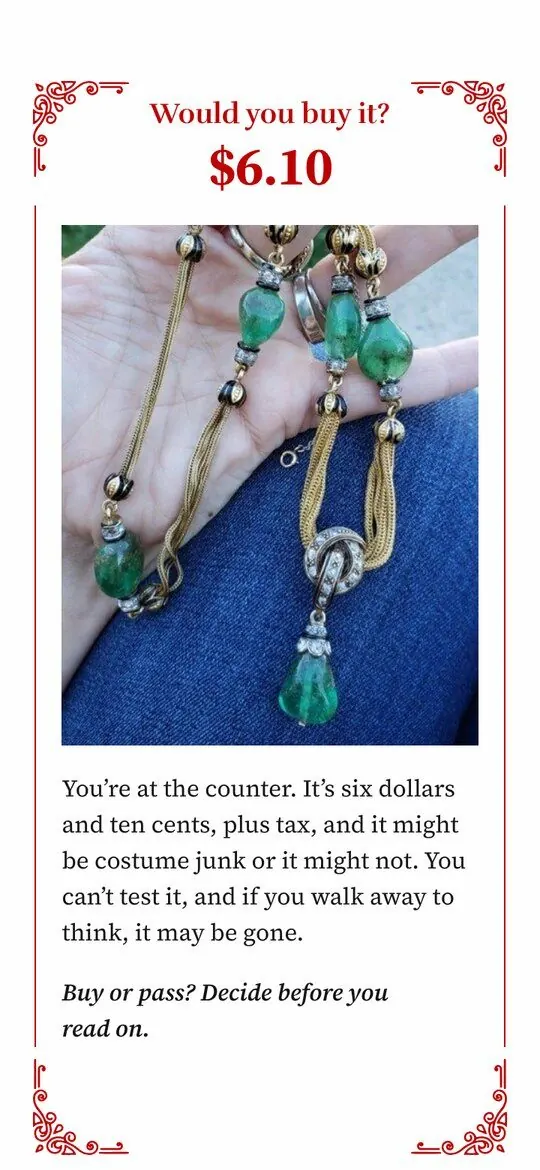
In 2021, a woman paid $6.10 for a thrift-store necklace the staff had priced as costume. Antiques Roadshow later valued it at $50,000 to $60,000.
This book teaches you to spot the real gold, silver, pearls, and stones that other shoppers walk past, and it’s a skill you keep for life.
Piece by piece, you can build a jewelry box that’s small but worth real cash, bought for pocket change.
Free chapter · read it here
How Ordinary People Find Real Treasure

In 2021, a woman at a thrift store spotted an ornate necklace in the display case: heavy links, green stones, a big drop pendant. It looked like it could be worth a fortune, or like Halloween costume jewelry, and through the glass she couldn’t tell. She posted it to r/ThriftStoreHauls, where people show off their secondhand finds.
The tag said $6.10.
“I usually hit the jewelry counter first and then go look at other stuff,” she wrote later, “but as soon as I touched it, I hopped in line and bought it and ran to my jewelry guy.”1
At the case, she had exactly as much information as you would have had: a gaudy piece, a weird and specific price, no way to test anything in the store, and employees who had looked it over, priced it, and put it in the case without a second thought.
If you’d have passed, you’re in the majority. One commenter wrote: “If I’d seen that I would’ve passed it as gaudy costume junk, and clearly a number of workers at the store did too.”2
Her “jewelry guy” looked at the necklace and estimated at least $2,000 in gold alone, and that was before anyone tried to count the stones, because the stones made it hard to even weigh the thing properly.3 So she spent a few hundred dollars of real money on a formal appraisal of a six-dollar necklace, which almost nobody does.
The appraisal letter said eighteen-karat gold. Its marks showed it was imported into France sometime between 1893 and 1990, and the style pointed to the early end of that range. The stones were real emeralds and real diamonds, more than she could count in the showcase that day. The appraised value was $45,000.4
That was money well spent. She still didn’t sell, and two years after she bought it, the necklace went on television, where the experts of Antiques Roadshow catalogued the metal, the marks, the stones, the construction, and the era, and gave it a name and a date: “Emerald, Diamond & Gold Necklace, ca. 1895.” They valued it at $50,000 to $60,000.5
Two comments under her final post sum up the reaction. “Still can’t believe you paid $6.10! A find of a lifetime.” And: “This frickin’ necklace will haunt my every thrift store jewelry rummage, forever.”
A find that size is rare. The jackpot was luck, but everything she did was skill, and you can learn that skill and use it at counters exactly like that one.
Someone owned that necklace before the thrift store did. They looked at an antique with two thousand dollars of gold in it, decided it was junk, and gave it away. Then trained thrift store employees handled it, priced it, and wrote $6.10 on the tag. At least half a dozen people held it without knowing what it was.
In almost every jewelry deal, one side knows more than the other, and the gap is where money changes hands unfairly: at the donation bin, the yard-sale table, the pawn counter, the cash-for-gold kiosk. Most people spend their whole lives on the wrong side of that gap. They sell too cheap, buy fakes, toss real gold, and get talked out of good pieces by confident strangers.
You may never inherit a box worth insuring, and you don’t need to. You need a trained eye. When you finish, you’ll be hard to fool, because you’ll know the floor price of what you’re holding, which test to run next, and when to stop trusting your own eyes and pay a professional.
A trained eye protects the money you already have, and it also lets you build. Piece by piece, at counters and yard sales and estate tables, you can put together a jewelry box that’s small but worth real cash, bought for pocket change because the seller didn’t know what you know. You don’t have to be rich to own real gold, but you have to be able to spot it. Every bad deal depends on you not knowing what’s in your hand, and once you know, nobody can exploit you that way anymore.
What you’ll learn
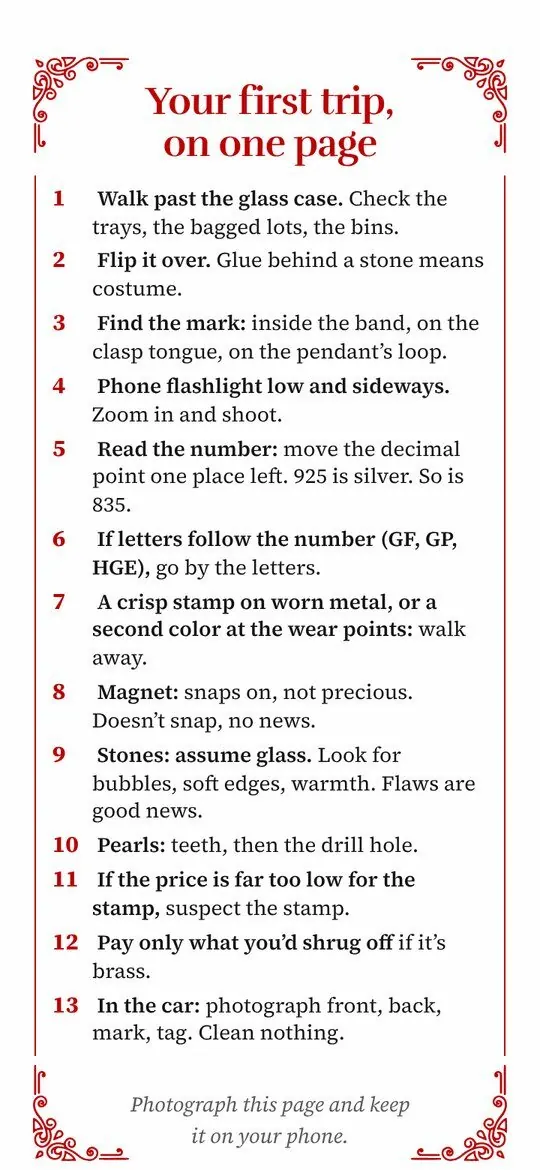
You won’t have to become a gemologist to recognize signs of hidden worth. You’ll learn where marks hide, what a fake stamp looks like, what real gold feels like in the hand, how to name the red stone in a ring before anyone tells you, which dozen names multiply a price, and what a scam feels like from inside.
You’ll have company. When a thrift-industry survey asked 8,912 North American shoppers why they do it, half said the treasure hunt is what got them started, and seven in ten said they’ve actually found a treasure at least once.6 Pieces like that necklace are still out there for anyone with a trained eye.
America’s largest generation is getting older and leaving its homes. People fifty-five and older own more than half of the owner-occupied homes in the country, boomers alone were 53 percent of last year’s home sellers, and the researchers who track family wealth expect $124 trillion to change hands by 2048.7 Estate-sale companies report that a death in the family, followed closely by downsizing, is what triggers most of their sales.8 When those houses get emptied, the jewelry lands exactly where you’re learning to look: the donation bin, the estate table, the mixed lot priced by the pound.
Sources
-
Original post and quotes: u/tomorrows-forecast, r/ThriftStoreHauls (2021), as quoted in “I bought a $6 necklace that looks like costume jewelry and it turns out the diamonds are real,” The Sun (US edition), January 26, 2024. Poster’s quote lightly repunctuated from the original post. ↩
-
Original post and quotes: u/tomorrows-forecast, r/ThriftStoreHauls (2021), as quoted in “I bought a $6 necklace that looks like costume jewelry and it turns out the diamonds are real,” The Sun (US edition), January 26, 2024. Poster’s quote lightly repunctuated from the original post. ↩
-
Yahoo Lifestyle, “Thrifter stunned by ‘Antiques Roadshow’ appraisal on ‘mystery’ $6 gold necklace,” December 19, 2025, quoting the poster’s updates (“Jeweler said at least $2,000 in gold but it’s hard to get an accurate weight because of the stones”). ↩
-
Appraisal details and the $45,000 figure as reported in Distractify, “This Woman Bought a Necklace at a Thrift Store for $6.10 — Turns Out, It’s Worth Thousands,” July 12, 2023, and The Sun (US), January 26, 2024, quoting the finder’s Reddit updates. ↩
-
PBS Antiques Roadshow appraisal (“Emerald, Diamond & Gold Necklace, ca. 1895,” $50,000–$60,000) and the community quotes as reported in The Cool Down, “Thrifter shocked after seeing $6 Goodwill necklace on ‘Antiques Roadshow’” (January 14, 2026) and Yahoo Lifestyle (December 19, 2025). ↩
-
Savers Value Village 2024 Thrift Report, survey of 8,912 U.S. and Canadian consumers: half of thrift shoppers say the potential treasure hunt is why they started; 8 in 10 enjoy the hunt; 7 in 10 report having found a treasure. ↩
-
Wealth-transfer projection: Cerulli Associates, “Cerulli Anticipates $124 Trillion in Wealth Will Transfer Through 2048,” press release, December 5, 2024 (roughly 81 percent from baby boomers and older generations). Home-ownership share: NAHB analysis of U.S. Census data (owners 55+ hold more than half of owner-occupied homes), as reported in HousingWire, June 24, 2026. Sellers’ share: National Association of Realtors, “2025 Home Buyers and Sellers Generational Trends Report,” March 31, 2025 (boomers were 53 percent of all home sellers). ↩
-
EstateSales.NET 2021 Industry Survey of 1,098 estate-sale companies: 49 percent named a death in the family as the most common reason for a sale; 46 percent named downsizing or moving. ↩

Five skills you’ll keep for life

- 1
Read any stamp and know what 925, 14K, 750, or GF claims.
- 2
Tell solid gold from plated in the store, before you pay.
- 3
Name the red stone in a ring before anyone tells you what it is.
- 4
Check pearls while you’re still in the aisle.
- 5
Know what the gold is worth before anyone makes you an offer.
A few real pages
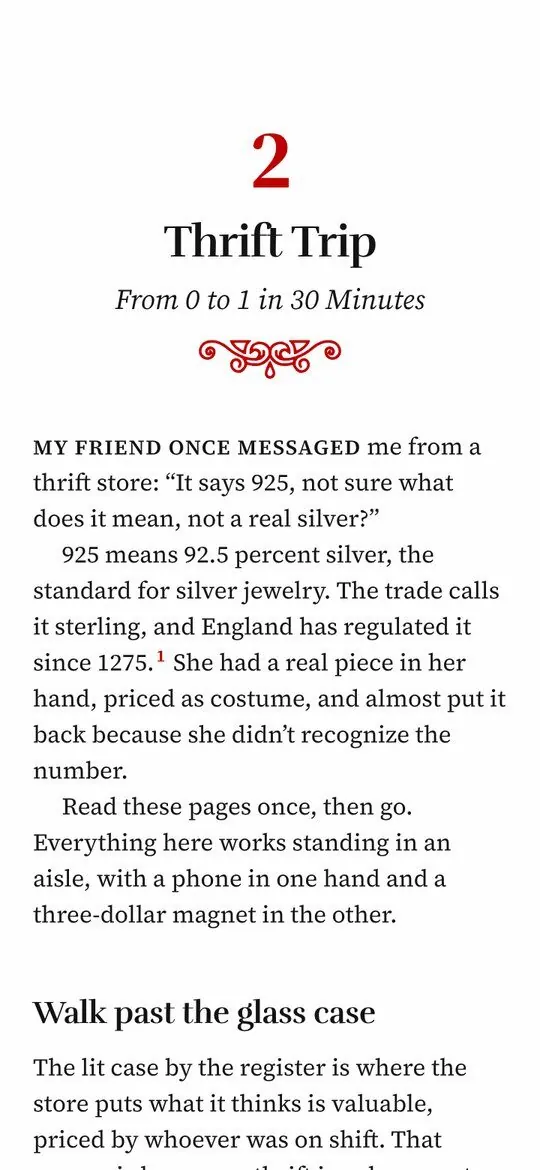
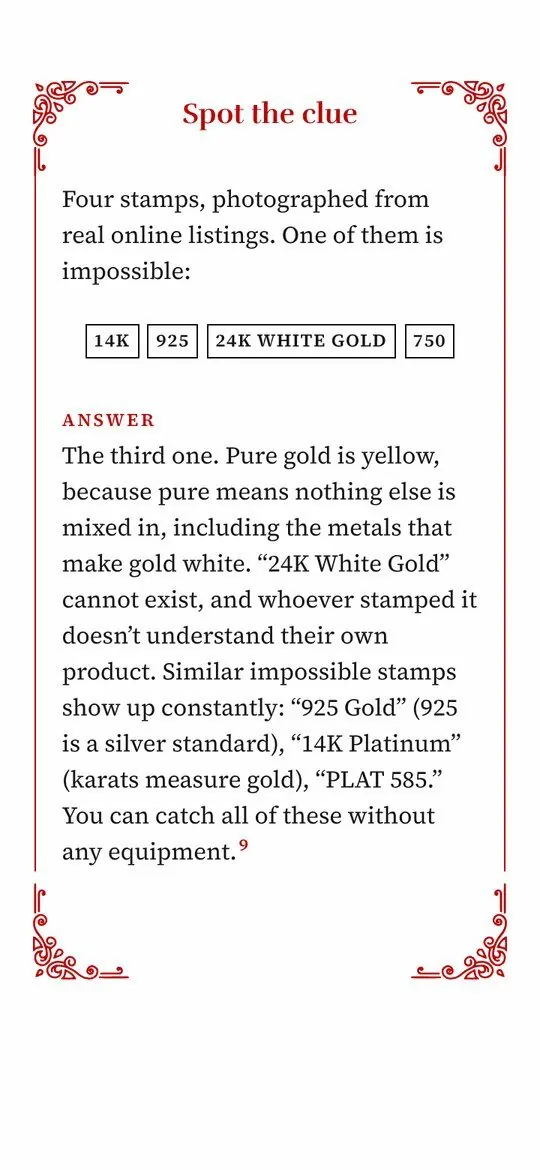
As they look on a phone.
Instant download · 30-day refund · Works on any phone or Kindle

Would you buy it?
$9.99
It’s almost ready. Leave your email and I’ll tell you the day it’s out.
Questions
I know nothing about jewelry. Is it for me?
Yes. The first four chapters start from zero, and they’re short enough to read over one Saturday coffee.
Do I need tools?
You need your phone’s flashlight and a small magnet. A 10x jeweler’s loupe, under $20, is a nice extra.
How do I read it?
On any phone, tablet, or Kindle. You download it right after you pay, and the link comes by email too.
Will it tell me what my piece is worth?
It shows you how to work out what the metal alone is worth, and when a piece is worth paying an appraiser to look at.

Free
The hallmark chart
All the common jewelry stamps on one page for your phone.
The printable chart is on its way. Leave your email and you’ll get it as soon as it’s done, plus a note when the book is out. You can unsubscribe anytime.